


“Trad wives” are very fashionable right now, by which I mean the Internet loves to hate-watch their TikToks and write think pieces about the women who ostensibly embrace traditional gender roles and perform homemaking for an online audience (which doesn’t feel especially traditional, but that is neither here nor there for the moment).
You may recall a certain Times profile from earlier this year which dubbed Hannah Neeleman (better known as Ballerina Farm) “queen of the trad wives,” despite the fact that Neeleman disavows that title in the article itself. The viral profile spawned both a deeply patronizing (in my opinion) wave of pity for Neeleman and a certain level of disdain for the lifestyle she promotes all while having access to resources the average person does not (like, for instance, a father-in-law who founded JetBlue Airways).
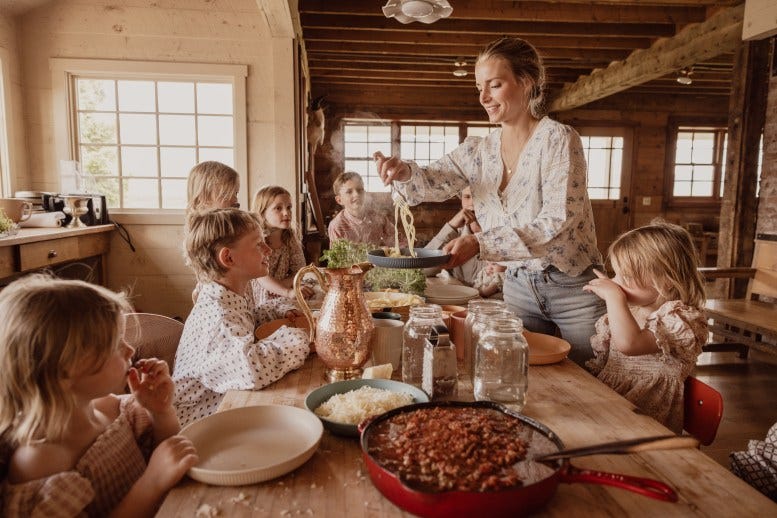
There is some romanticization that can exist around the trad wife industrial complex — who doesn’t want to breeze through life in Christy Dawn dresses and make mozzarella from scratch? But today’s trad wives, who seem to exist predominantly on perfectly curated social media accounts, have both a predecessor and an ideology that are somewhat more modern than they’d like you to believe.
As a child and then a teenager growing up in the world of deeply conservative fundamentalist Christianity, I was governed by a principle that I think many of us who come from such a world found hanging over us: that God had one precise purpose for my life, and I just had to figure out what it was. I was looking for an obvious path, and when I found it, I knew it must be exactly what God wanted of me because I immediately hated it. I found a community of young women just a few years older than I who were living proof that certain purpose was possible, a theology that handed me a precise role to play. In short, I found Stay-At-Home Daughters.
Biblical Patriarchy, Vision Forum, and Knock-off American Girl Dolls
Biblical patriarchy, the foundation of the Stay-At-Home Daughter movement, was hardly unfamiliar to me as a fifteen-year-old. Any involvement in the world of fundamentalist Christianity practically ensures your exposure to this strictly-gendered conception of God and human nature. While plenty of patriarchal influences had already wormed their way into my life by the time I learned about Stay-At-Home-Daughters (from the advocates of biblical patriarchy who spoke at our local homeschooling conferences to the pressure exerted on many of my friends to forego higher education in favor of marrying and mothering as soon as possible), one of the most notable patriarchal forces both in my own life and in the broader world of Christian homeschooling was Vision Forum.
A ministry founded by Doug Phillips (who resigned and shuttered Vision Forum after allegations of his sexual abuse emerged), Vision Forum’s stated mission was to “reinforce godly masculinity and femininity.” Phillips produced a document entitled “The Tenets of Biblical Patriarchy,” which decries any attack on patriarchy as heretical because “God reveals Himself as masculine, not feminine.” Through this unabashedly binary lens, Phillips argues that specific gender roles, in which men hold authority over women and women exist as “helpmeets” to men, are to be performed in service of aiding the church’s mission to take dominion over the created world. Failure to do so results in the breakdown not only of society, but of the church’s very ability to survive. Horror!
For nearly fifteen years, Vision Forum mailed glossy catalogs to a readership primarily composed of Christian homeschooling families across the country, advertising products under headings like “Biblical Patriarchy Made Simple.” A book entitled Home-Making guaranteed a reliable blueprint for instituting the “cultural dominion of the Christian family.” Another instructed parents on how to arrange marriages for their children. Yet another inquired ominously, “Who Controls the Womb?”
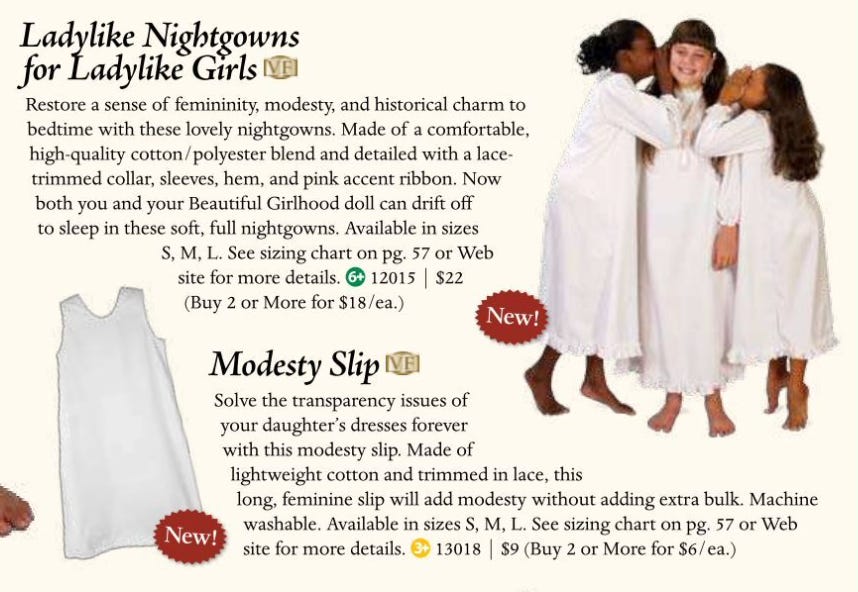
Look, I’m not above saying that I desperately wanted one of these nightgowns as a child. The girls yearn for Hill House. (Not the “modesty slip,” though).
Reading material and audio lectures veered into historical territory, such as “Pilgrims vs. Indians: Racial Genocide or Biblical Dominion in Colonial New England?” (Take a wild guess as to what Doug Phillips thought the answer to this question was). After these titles came a toy section. The All-American Boy’s Adventure offered boys the chance to “rescue the damsel in distress” or “explore America with Lewis and Clark.” To aid in the quest of establishing masculinity, boys could purchase a Continental Soldier’s Field Drum, a William Wallace Sword, or an All-American Pop Gun.
Products marketed to girls (and their parents) were of a decidedly different dimension. The Beautiful Girlhood Collection (an obvious American Girl rip-off) promised to provide girls with a vision that could withstand a world which “frowns on femininity” and “minimizes motherhood,” thanks to dolls with names like Liberty and Evangeline certain to “fill your daughter’s childhood with memories to inspire her as she grows up to be a mommy.”
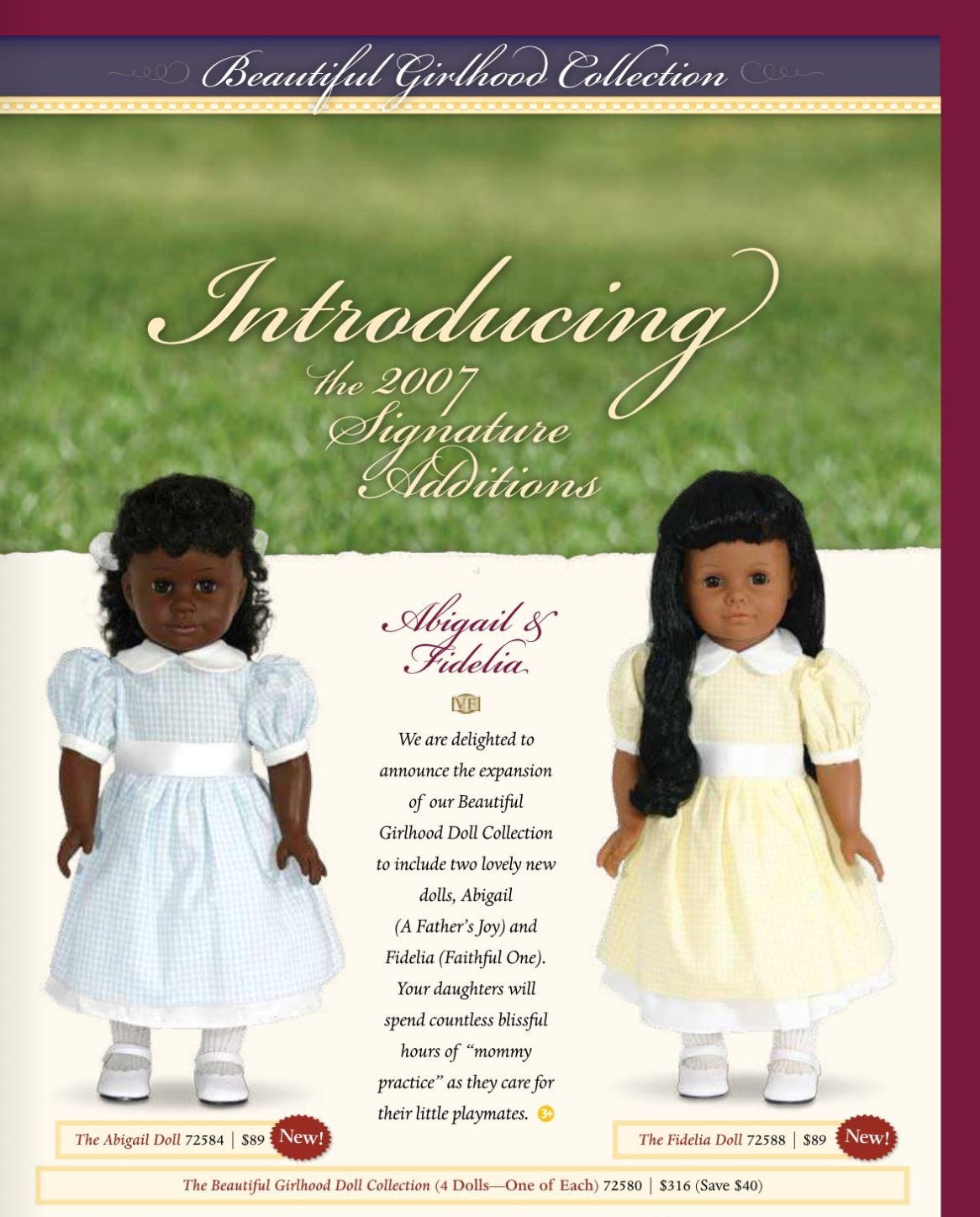
Personally, if I had gotten one of these dolls for “mommy practice” instead of Kit Kittredge when I was eight, I would have been livid.
Included in the collection was a Father-Daughter Purity Locket, intended to be presented by fathers to daughters in order to signify that a daughter would remain “under her father’s protection until the time of release to her future husband.” Capping this delightful selection of products was a book entitled So Much More: The Remarkable Influence of Visionary Daughters on the Kingdom of God by Anna Sofia and Elizabeth Botkin.
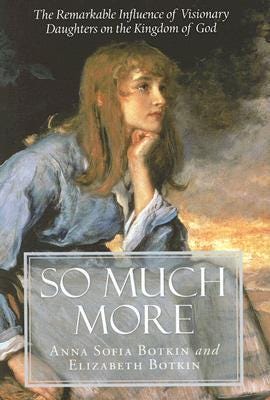
So Much More Than What, Exactly?
The Botkin sisters published their manifesto in 2005 through Vision Forum at seventeen and nineteen years old, sparking a small revolution of sorts within the world of Christian homeschooling. The daughters of fundamentalist author Geoff Botkin, the Botkin sisters practiced what they preached: they skipped college and careers to stay at home under the “headship” of their father, learning how to be good helpmeets to their eventual future husbands. Their choices should not be viewed as unique, the Botkins argued; rather, all Christian young women were called to this lifestyle, in what they termed a return to the practices of godly women in more God-fearing times.
(When exactly those times were and what did they look like, you might ask? Well, the Botkins were light on specifics).
In 2007, the Botkin sisters released a documentary in partnership with Vision Forum entitled Return of the Daughters: A Vision of Victory for the Single Women of the 21st Century. In the documentary, Anna Sofia and Elizabeth interview other Stay-At-Home Daughters alongside their fathers. These daughters speak passionately about the lifestyle they say they have chosen; their fathers sit next to them, constant presences throughout.
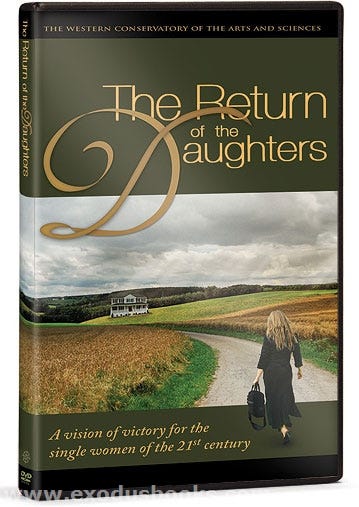
As a teenager, I first pored over the Botkins’ book and watched the documentary in a span of days, which left me both unnerved and intrigued. Anna Sofia and Elizabeth seemed to have intuited the question I had been asking — what did God want from me? The answer they provided was unambiguous, but it was not an answer I liked: my calling, and the calling of every young woman like me, was to fashion myself into an impeccable helpmeet to the men in my life — first my father, and then, given his approval, my husband.
The term “helpmeet” is laden with years of scholarly debate, but the Botkins had no qualms regarding its meaning. For them, it was straightforward: being a helpmeet meant that women were, by their very nature, subject to the protection and the authority of men. Every woman was not subject to every man, but every woman would always be subject to some man: her father and then her husband.
A future helpmeet was not to pursue higher education, at least in the traditional sense (colleges were “corrupting influences of Marxist indoctrination”). She was rather to focus on “advanced homemaking skills” (I assume this is where baking sourdough comes into play) and further her scholarship via distance learning, if that was of interest to her and (more importantly) approved by her father. She was not to hold a job outside the home, but rather was to dedicate her time and energy to serving her family, especially her father, in whatever way her father and her family wanted her to serve them.

Anna Sofia and Elizabeth Botkin, circa 2008.
In the 2000s and early-to-mid 2010s, Stay-At-Home-Daughters inspired by the Botkins often found others of their kind through So Much More and Return of the Daughters, which were sold by Vision Forum at Christian homeschooling conferences attended by thousands of families across the country. Before the prominence of social media, and certainly in part because these already-conservative families were even more conservative about their daughters’ internet usage, these young women found each other online on forums like Raising Homemakers (which used to publish articles like “So You Think You Should Go To Work?” and now seems to mostly publish vaguely British recipes) and on their own personal blogs, in which they would trade tips on the Stay-At-Home-Daughter lifestyle under pseudonyms.
At the age of fifteen, I read those blogs religiously, trying to see if I could truly find myself in this small community or if (better yet) I could uncover the loophole that would let me escape it while still being a good Christian girl. I found myself painfully (and rather melodramatically, because again, I was fifteen) torn between two apparently irreconcilable paths: follow God and abandon every other dream I had to become someone’s helpmeet, or deny God and doom myself in the process.
Joy, Regret, and Peer Pressure
Perhaps I would have found it easier to dismiss the Botkins’ call out of hand had it not been for one of the figures in their documentary. Jasmine Baucham, now Holmes (yes, the daughter of that Voddie Baucham), was an ideal, persuasive spokesperson for Stay-At-Home-Daughters. In Joyfully at Home, also published by Vision Forum, Jasmine wrote of her Ivy League aspirations and her dreams of becoming a screenwriter (both of which I shared) and how she was ready to give all those dreams up — because she had found something better.
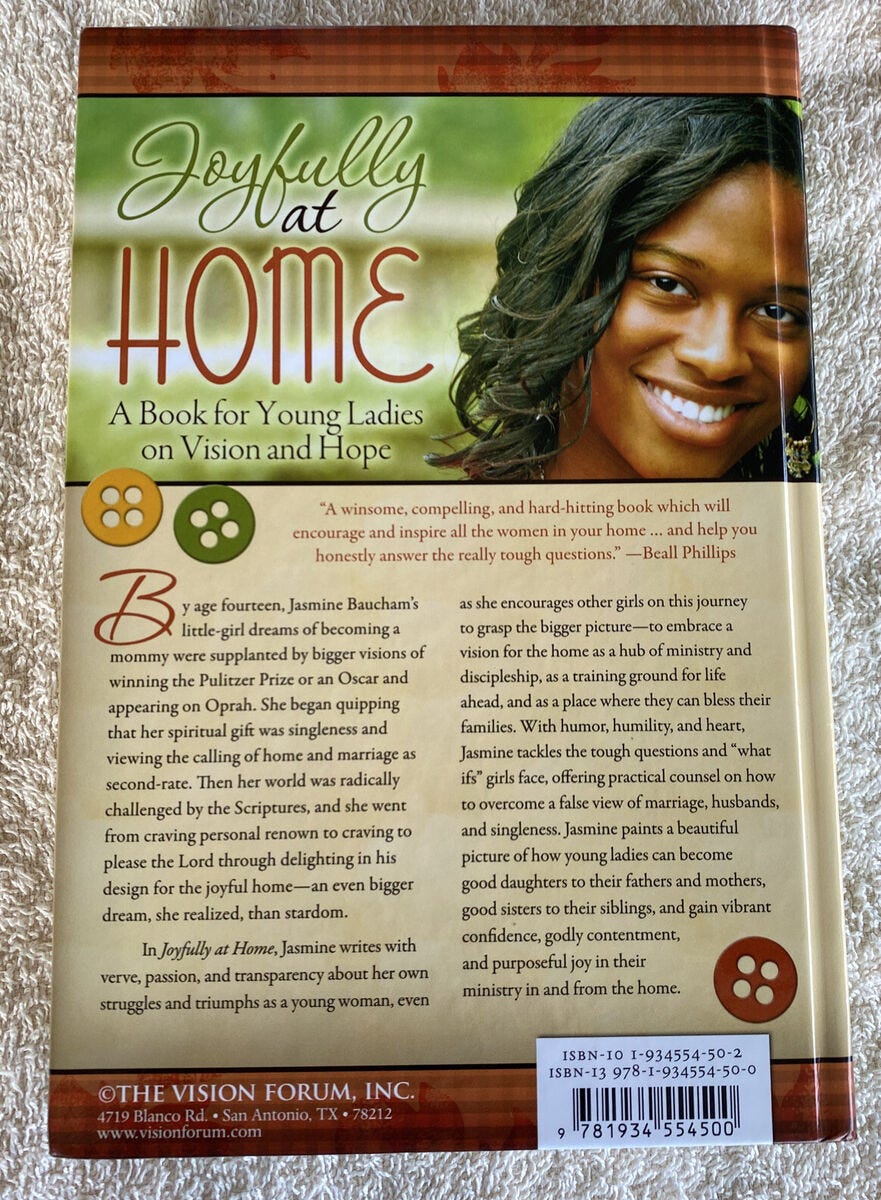
Recommended by Doug Phillips’ wife, no less!
Jasmine, like me, encountered the Botkins’ book as a young teenager. She embraced the higher purpose of staying at home, serving her father and her family and becoming the woman God loved. The proof-texted Scriptural support within So Much More, the oppressive theology inherent to the biblical patriarchy movement, the simple fact that I instinctively shrank from embracing this lifestyle altogether — all of this I could have probably easily rejected, but I found it much harder to counter the lived experience of a person whose story seemed so familiar, who was striding down a path with the kind of decisiveness for which I was searching.
Of course, it is crucial to note, I was never actually a Stay-At-Home-Daughter. I had a family who never thought to impose this lifestyle upon me. Most Stay-At-Home-Daughters in the 2000s and 2010s were homeschooled by families who did not provide them access to transcripts, standardized testing, or external assistance to navigate the process of applying to colleges and securing financial aid. They were not allowed to hold jobs outside of the home, they had little-to-no access to the world outside of their families, they largely had nowhere to go even if they mustered up the tenacity to leave.
None of this remotely applied to me. But nevertheless, I was torn. I had wanted to know God’s will, hadn’t I? Well, here it was, and I found that I did not want it after all.
Yet I was terrified that I should want it, and spent the next several years angling to conform my desires to the Botkins’ mold. Should I aim for college at all, I wondered? If I did attend college, should I study something practical that would make me a better helpmeet to my eventual husband? If I pursued a subject that was not strictly pragmatic, exactly how long would I be able to maintain the pretense that I had a life of my own before I would have to get married, raise children, and live in the only fashion that would be acceptable to God?
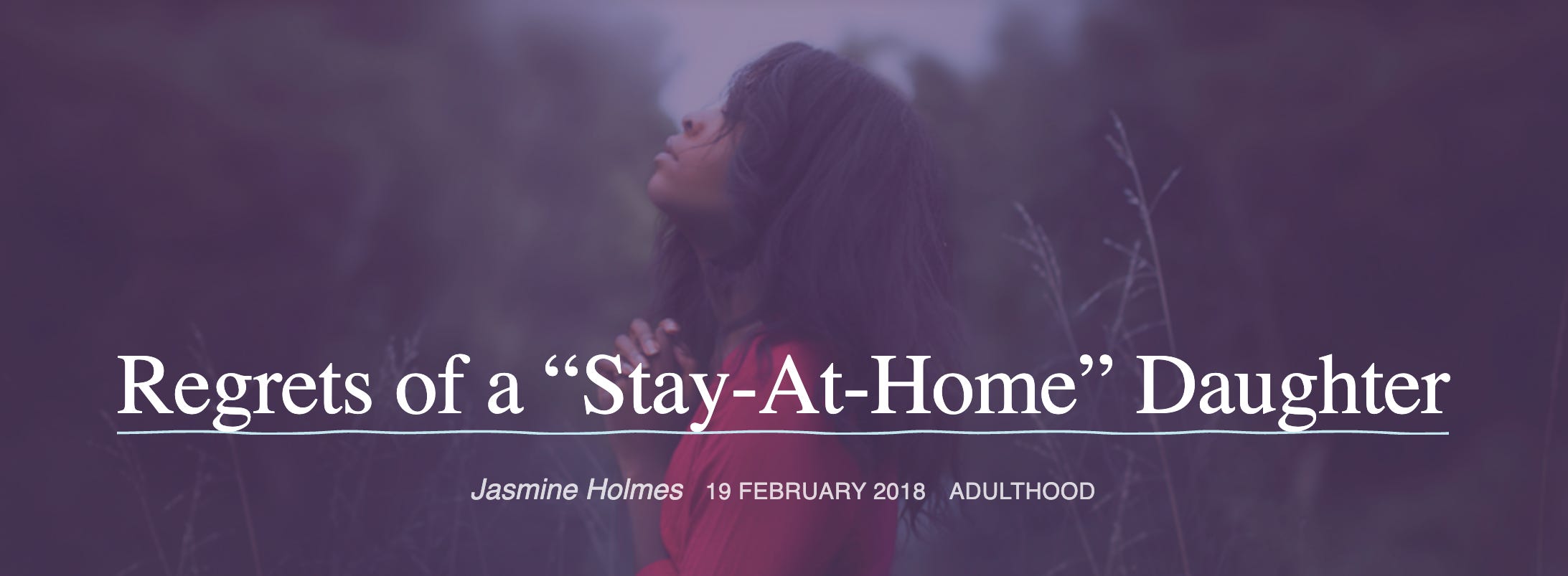
Jasmine’s evolution since her days as a Stay-At-Home-Daughter is a fascinating one to me — and frankly, one I wish I understood better. She is an author and a teacher, and has written only sparingly about her former life as a Stay-At-Home-Daughter. In a piece entitled “Regrets of a Stay-At-Home-Daughter,” Jasmine’s titular regret is characterized by embarrassment:
I’m not embarrassed by the fact that I chose not to move out until I got married. I’m not perfectly content with it either… I’m embarrassed because I considered making staying home until marriage into a righteous movement instead of one valid option among many is a mistake that has caused myriad ripple effects of shame and insecurity in so many lives. Including my own.
Here, Jasmine does not dismiss the Stay-At-Home-Daughter movement so much as she comments on the space it took up in the lives of young women, presented to them as their sole option instead of one choice among many. Like the young women who identified her book as a turning point in drawing them to the Stay-At-Home-Daughter movement, Jasmine identifies the work of the Botkins as something she was drawn to by her own pure choice.
[So Much More] presented a picture of the daughter, not as an individual agent, but an integral part of the family dynamic. Why would I go off to college and do my own thing when I could become part of my family’s incredible mission in the world? It got me. Hook, line, and sinker.
But how much choice can actually be involved in a world in which you, as a woman, are instructed continually that you are subservient to the men in your life, that you will only truly gain God’s favor and love if you twist yourself into the shape of a helpmeet — a world in which you never consider what you might actually want?
What Kind Of Choice Is That?
I wasn’t the only one to be taken in by the prospect of questions answered, a definitive path to follow. Bailey Bergmann Steger, a former Stay-At-Home-Daughter, chalked much of her participation in the movement up to the answers it, and its emphasis on biblical patriarchy, provided:
Here was what my heart longed for: a simple path to living as a “Biblical woman,” a clear way to please God. Being a stay-at-home daughter encompassed all aspects of my life—clothes (skirts only), relationships (no crushes), higher education (don’t), occupation (make a home)—and all seasons of my life (as daughter, serve dad; as wife, serve husband; in the absence of either, serve brother or pastor). The desire to obey the Bible, be a “good Christian,” and, most importantly, make God happy enough to never send me to hell plunged me deep into patriarchy at the age of eleven.
Like myself, Bailey was encouraged by Jasmine’s early writings on the Stay-At-Home-Daughter movement — for Bailey, Jasmine’s words “emphasized the freedom in Christ to live as individuals within God’s given design.”
Of course, “God’s given design” was for daughters to stay at home under the headship of their fathers, but Jasmine’s language made at least some measure of room for the individuality of the young women who were inducted into this movement. But eventually, even the promise of some minimal freedoms were not enough for who Bailey was and what she wanted to be.
I wanted to go to college. I wanted to get out of a small town and learn about different people. I wanted friends beyond my loving family. I wanted a job and an income to occupy my time. And I could do none of those things as a Stay-At-Home-Daughter… the more I tried smashing the dreams and goals and traits that gave me purpose and joy, the more I was miserable.
Rebels With A Cause
One sneakily persuasive tactic employed by the Botkin sisters throughout So Much More was a neat bit of appropriation of counter-cultural language. One former Stay-At-Home Daughter told her story via Homeschoolers Anonymous, a place for those who grew up in the fundamentalist world of Christian homeschooling to discuss their experiences, under their real names if they felt safe doing so or under aliases if not. Writing under the name “Reumah,” this self-described Stay-At-Home-Daughter who “rebelled” recounts her first introduction to the movement:
My excitement was palpable as I unwrapped the most recent birthday gift from my well-meaning parents; Vision Forum’s newest DVD release Return of the Daughters promoting Biblical womanhood and a return to the supposed woman’s role in the home.
If you were a teenaged girl encountering this documentary, you were presented with some very strategic rhetorical choices: this piece of media was, according to the summary on the back of the DVD, “highly-controversial,” full of stories of young women who “dared to defy” the culture and “pioneer” something entirely new, something with stakes that reached so high they could not be attained via any other means.
Reumah, who had by this point already finished her parents’ homeschooling curriculum for high school, was enticed by this language. The Botkins’ documentary, which was at one point shown in Reumah’s church in lieu of a sermon, escalated this already-captivating message:
To my innocent and sheltered sixteen year old mind, this sounded like the ultimate ideal. Controversial? Check. Counter cultural? Check. Revolutionary? Check… I watched in awe as my female ideals, Anna Sofia and Elizabeth Botkin, looked into the camera with their poised grown-up demeanor and proclaimed their truth; that feminism was all a lie. An evil ploy by secular humanists to destroy the family and take women away from their God-given sphere. A Communist plot to chip away at the fabric of Christian society. That by going to college, holding down jobs, and leaving our father’s protection, we were unwittingly playing right into their hands and helping them destroy God’s design for families. And what’s worse is, it all sounded so plausible.
Not only did the Botkins’ documentary carry a dire warning with the highest possible stakes, it also promised that being a Stay-At-Home-Daughter was the most rewarding path for young women because it was the only path that truly understood the plight of today’s teenaged girl. All this was told from the perspective of two refined young women who could confidently say they had stood in the shoes of the barely-teenagers who were drawn to the Stay-At-Home-Daughter movement, searching for some kind of meaning, desperate for someone to understand them.
Reumah describes herself as an initial willing participant — as willing as she could have been in a world that presented her with no other choices:
I had no trouble swallowing what Anna Sophia and Elizabeth Botkin were all too eager to dish out. In their documentary, they portrayed graceful young women in their early twenties busily staying at home helping their mothers, teaching their young siblings, cooking delicious dinners for daddy, and sewing modest clothing just like the Proverbs 31 woman. They made it all look so important. So purposeful.
For someone like Reumah, the choice — or at least, the lack of options — that led her to become a Stay-At-Home-Daughter was one that came easily, as she could embrace it with a clear understanding of her own purpose. Yet Reumah’s story also perfectly illustrates the illusion of freedom that the Stay-At-Home-Daughter movement provided. As she spent more time at home, and as her family increased the strictness of their rules, Reumah came to a realization:
I didn’t have anything to look forward to, and the glorious prospects of winning the culture war and raising a family of warriors for Christ began to seem a little bleak. I began to envision the reality of the future I had willingly committed to, and it wasn’t a prospect I liked at all. Yet, in spite of my growing restlessness, I was trapped. No, I wasn’t being forcibly held at home. My family loved me, and I loved them. But I slowly began to see the bars of the invisible prison into which I had unknowingly walked.
As a young twenty-something, Reumah found herself without any real skill set with which to support herself. Homeschooling meant that Reumah had never participated in any extracurricular activities or held any job outside of her household. Requests to look for some part-time work were quickly dismissed by her father, who reminded her that she already had a job: serving him.
At the age of 21, Reumah secured her first job outside of the home, a part-time retail position. It is this job, this first experience with the wider world, that opened Reumah to an entirely different way of living:
One morning when I came down for breakfast wearing my favorite pair of jeans, my father told me that he was ashamed of my immodest clothing, and that I wasn’t allowed to wear those jeans ever again in his house. As a 21 year old woman who’d tasted just enough independence to understand what she was missing, I was livid. I started keeping the jeans at work, and changing into them as soon as I left my parent’s house. My days of quietly obeying my parent’s directives were quickly coming to an end.
In a turn of events Reumah termed “miraculous,” she applied to and received a scholarship to a college that would take her across the country from her family, a pursuit that her parents informed her they would never permit — and yet she left anyways.
A New Vision
The last time I heard Doug Phillips speak was at a homeschooling conference over the summer between my freshman and sophomore years of college. I’d spent the morning wandering the cavernous hall in which hundreds of Christian booksellers marketed their wares. I sidestepped the Vision Forum booth, staffed by an interchangeable array of boys in suits, books by the Botkin sisters displayed prominently alongside curriculum on homemaking and audio lectures on the mandates of Biblical Patriarchy, before slipping into one of Phillips’ lectures. (Why, you ask? I couldn’t tell you).

The man himself.
His material was familiar — standard recitations of patriarchal theology — but it felt darker, stranger to me, than it had in years past. Perhaps I was listening more closely. Phillips spoke of the threats posed to the family (liberal legislators, secular public schools, all the usual suspects) and — women’s suffrage? I shifted in my seat, wondering if I had misheard. Alas, I had not. Phillips was suddenly shouting that the moral decay of American culture could be traced in large part to the insubordination women exhibited against their husbands when they demanded the right to be heard.
Women and men alike stood up to cheer. I left the lecture.
A year later, Doug Phillips was sued by a former Stay-At-Home Daughter for the alleged sexual abuse he perpetrated against her, and Vision Forum went dark.
I had moved far from the confines of the world of biblical patriarchy by this point, but I could still feel its rippling effects in my psyche — and my experience with this world was relatively light, all things considered and certainly compared to others who fell, or were dragged, more deeply down the rabbit hole.
I wish I knew what the Anna Sofia and Elizabeth Botkin were up to these days, what their lives look like now. They stopped publishing on their website in 2018. I would love to ask them what they think now about their lives as Stay-At-Home-Daughters, how they feel about having been catapulted to (minor) fame in the spotlight of the Christian homeschooling world, if they have any regrets. They were so young when they became the faces of this movement, selling an ideology handed down to them by the insulated world of biblical patriarchy to other young girls.
We were all too young.
That's quite a trip! Thank you for sharing your experience. As the daughter of a father that encouraged me to try and be anything I could envision, I find self-oppression and the oppression of other women difficult to accept.
Thank you for writing this. I remember coming across Vision Forum and Ladies Against Feminism in the mid 2000s. My dad would have laughed me out of the room if I asked to be a stay-at-home daughter. I yearned for the stability the articles on these sites conveyed. It was all a fantasy, but so persuasive. I still sometimes go back and reread some of the posts, not all bad, but some were downright dangerous. I sometimes wonder what happened to the Botkin sisters.